

If you’ve ever felt like your fitness progress just…stopped, you’re not alone. Nearly everyone hits a plateau at some point, especially after 50, when life, hormones, and energy can all shift the playing field. I’ve been there too, staring at the same weights, wondering why what used to work suddenly feels like running in place.
When Progress Stalls: Why It Happens
First, give yourself credit for being consistent, that’s half the battle. Plateaus are a normal part of the process, not a sign of failure. They can happen for lots of reasons: your body adapts, routines get stale, or life simply gets in the way. The good news? You don’t need to overhaul everything. Sometimes, a few small tweaks make all the difference.
The FITT Principle: Your Secret Weapon When Progress Stalls
You’ve been consistent with your workouts. You’ve shown up, done the work, and felt good about your commitment. Then one day you notice: nothing’s changing anymore. The weights that used to challenge you feel routine. Your body seems to have settled into a comfortable groove, and that initial momentum has quietly slipped away.
If this sounds familiar, you’re not experiencing failure. You’re experiencing adaptation, and that’s actually a sign of success. Your body has gotten stronger and more efficient at what you’ve been asking it to do. Now it’s simply waiting for the next challenge.
This is where the FITT principle becomes invaluable.
What Is the FITT Principle?
FITT is a straightforward framework fitness professionals use to design and adjust exercise programs. It stands for:
- Frequency: How often you exercise
- Intensity: How hard you work during each session
- Time: How long each workout lasts
- Type: What kind of activity you’re doing
The beauty of FITT is that you don’t need to overhaul your entire routine when progress stalls. You just need to adjust one or two variables, give your body a new stimulus, and watch how it responds.
Using FITT to Break Through a Plateau
Let’s look at how you might apply each element when you notice your progress has leveled off.
Frequency is about consistency and volume. If you’re currently strength training twice a week, consider adding a third session. It doesn’t have to be a full hour in the gym—even a 15-minute session with resistance bands or a brisk walk with intervals can provide that extra stimulus your body needs to keep adapting.
Intensity is where many women over 50 leave progress on the table. We get comfortable with certain weights or certain speeds, and we stop pushing just a little bit harder. If your usual dumbbells feel manageable throughout all your sets, it’s time to increase the challenge. Add five pounds, do an extra rep or two, or slow down your tempo to increase time under tension. Your body will only grow stronger when you ask it to do something it couldn’t quite do yesterday.
Time can be adjusted in small increments. If you’ve been doing 20-minute workouts, try 25 or 30. If you’re walking for 15 minutes, extend it to 20. Even adding one more set to your strength routine counts. These small increases accumulate over weeks and months into significant improvements.
Type is the variable most of us overlook, yet it might be the most important when you hit a plateau. Our bodies are incredibly adaptive, and when we do the same movements day after day, they become efficient at those specific patterns. Efficiency is wonderful for daily life but not ideal when you’re trying to build strength or fitness. Try swapping your usual elliptical session for a bike ride, your dumbbells for resistance bands, or your strength routine for a yoga class. The novelty alone can reignite progress.
The Strategy: Change One Thing
Here’s what works: pick one FITT variable and adjust it for a week or two. Don’t try to change everything simultaneously. Add one workout session or increase your weights by the smallest increment available. See how your body responds. Notice whether you feel more challenged, whether you’re sleeping differently, whether your energy shifts.
Sometimes just breaking the routine is enough to restart progress. And sometimes you’ll discover that the change you made wasn’t quite right, so you’ll try a different variable instead. This is normal. You’re learning what your body needs, and that’s valuable information you can use for the rest of your life.
Progress Isn’t Always Linear
One thing I’ve learned both personally and through working with women over 50: progress rarely looks like a straight line going up. There are plateaus, there are weeks when life gets in the way, there are periods when your body needs rest more than it needs intensity. That’s not failure—that’s being human.
What matters is having a framework like FITT to return to when you’re ready to move forward again. It takes the guesswork out of “what should I do differently?” and gives you clear, actionable options.
Tracking Makes the Difference
If you’re serious about working through a plateau, tracking your workouts becomes essential. It’s hard to know whether you’re actually progressing if you can’t remember what you did last week. Did you use 10-pound or 12-pound dumbbells? Did you do two sets or three? How did it feel?
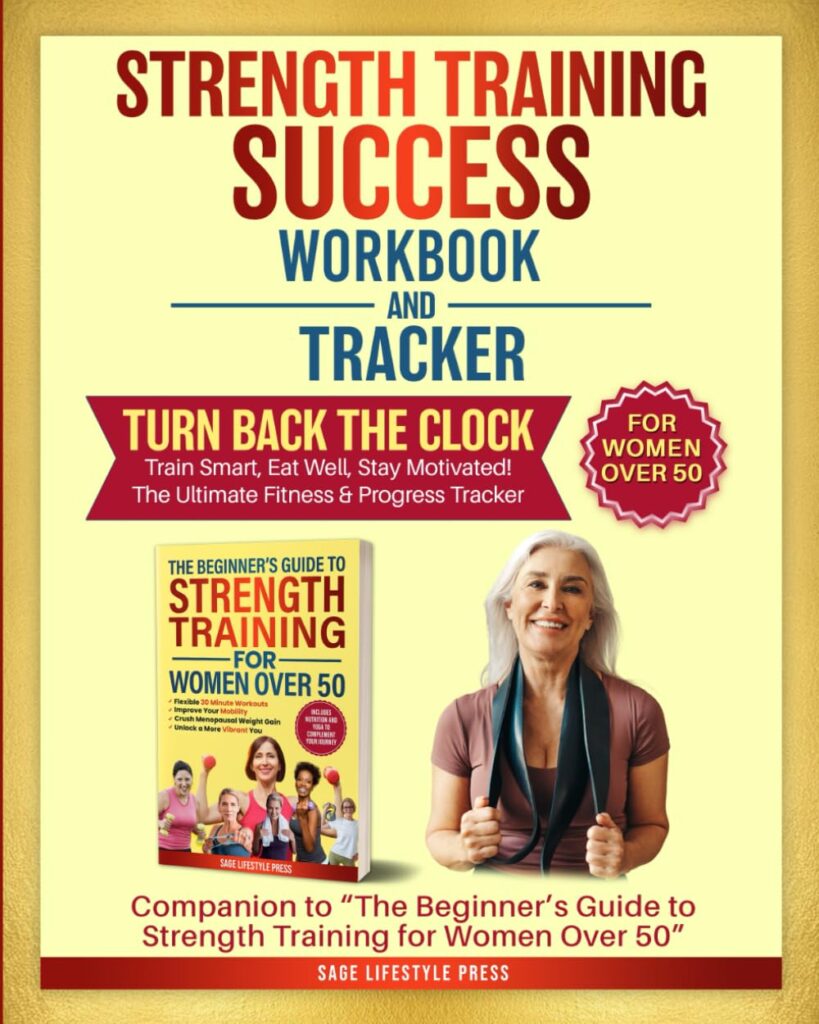
That’s why I created the Strength Training Success Workbook & Tracker. It gives you templates and progress logs designed specifically for women over 50 who want to stay motivated, see their improvements, and celebrate the wins that might otherwise go unnoticed. When progress feels slow, having a record of where you started makes all the difference.
You’re Stronger Than You Think
Here’s what I want you to remember: a plateau isn’t a dead end. It’s a signal that you’ve adapted to your current routine, and your body is ready for something new. That’s remarkable. You’ve done the work, built consistency, and gotten strong enough that what once challenged you no longer does.
Now you just need to turn the dial slightly—add a session, increase the weight, extend the time, or try something different. Pick one variable from the FITT principle and make a small adjustment. Then pay attention. Your body will tell you what it needs.
Growth is still possible. Strength is still within reach. And you’re absolutely capable of getting there.
For more practical guidance and encouragement along the way, explore the Sage Lifestyle Press website for free resources designed specifically for women 50 and beyond.
You’ve got this.